Tuskegee University offers over 60 academic programs to choose from.
Tuskegee University is ranked as the #4 HBCU in the Nation.
Get ready to take flight… because your journey to greatness starts here!
Tuskegee University is the only HBCU to proudly offer ROTC Programs for all of the military branches, including the Space Force!
We have over 100 student organizations on campus, and Championship sports teams for men and women!
May 2, 2026 | 9:30 a.m.
General Daniel "Chappie" James Arena
Speaker: TBA
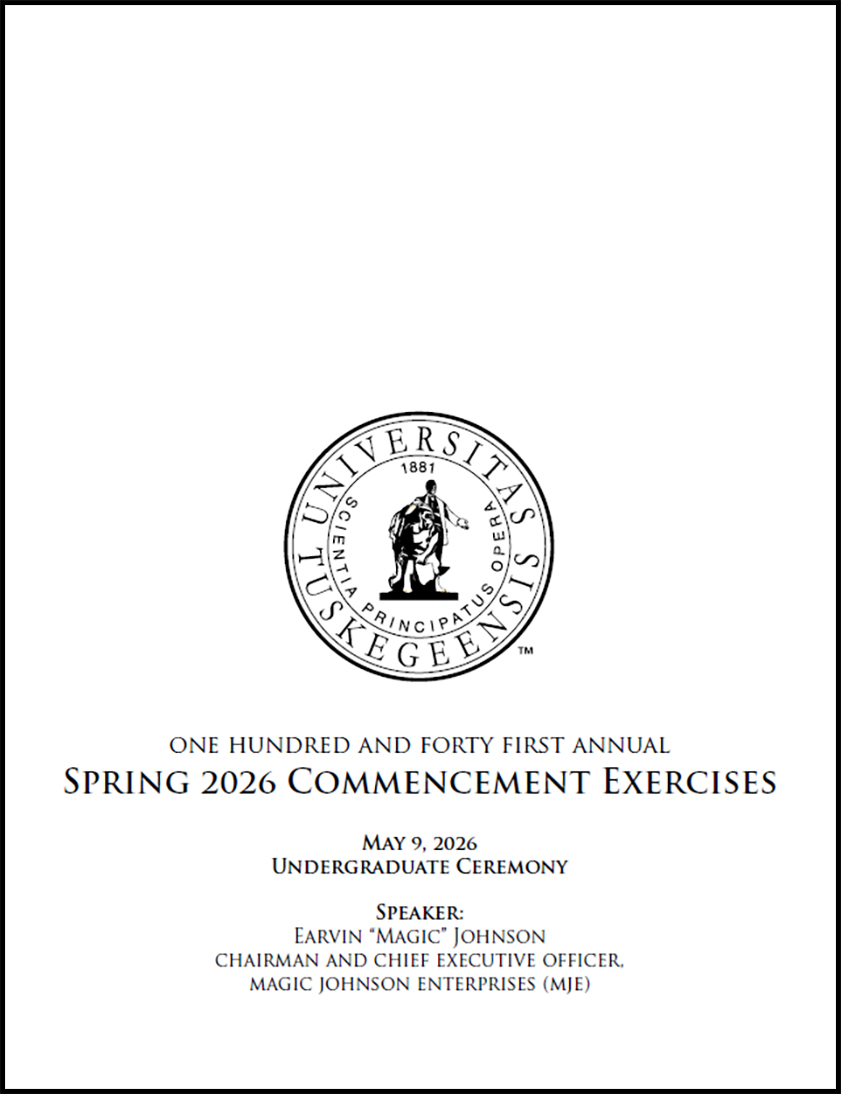
May 9, 2026 | 12:30 p.m.
General Daniel "Chappie" James Arena
Speaker: TBA
The approved cap of the academic costume is the mortar board or Oxford cap- a stiff board nine inches square, usually covered in cotton poplin, Russell cord, or spun rayon, placed on a soft cap made of the same material and jointed in a pointed design in front and back. The front of the cap is shorter than the back, but the color is always that of the gown and is uniformly black for the four-year colleges. The use of velvet material has been reserved for the cap for the doctor’s degree. A silk cord with a tassel made of many strands of threads is attached to a button in the center of the board. The length of the cord and tassel may vary with the degree of the wearer.
The basic design for gowns is similar for all degrees; the minor variations in fullness and length of sleeves and trimmings are indicative of degree levels. Cotton poplin fabric is used for the bachelor’s and master’s gown, and ribbed rayon or silk material is reserved for the doctor’s gown.
No longer worn for warmth, the hood has become the colorful standard bearer of academic symbolism. It varies in length from three feet to three and a half feet, representing the bachelor’s, master’s, and doctor’s degree, respectively. The colors or colors of the lining of the hood is trimmed or edged in a border of velvet either two inches, three inches, or five inches in width for the bachelor’s, master’s and doctor’s degree. The border color represents the faculty or field of study in which the degree was awarded.
Information taken from The Admissions, Academic Records, and Registrar Handbook of Policies and Procedures, C. James Quann and Associates: 1979.
In recognition of scholarship of high quality, a student may graduate with distinction according to the following cumulative grade point averages:
Candidates for honors must qualify one semester prior to commencement. Regalia for honor students will be issued at graduation rehearsal. Students are permitted to keep honors regalia.
All seniors completing graduation requirements should place orders for graduation regalia with the Tuskegee Campus Bookstore. Order should be placed early to receive regalia in time for the Commencement Ceremony. For more information (regarding regalia and invitations), call 334-727-8844.
All degree candidates should dress in a manner appropriate for the dignity and solemnity of the University’s Commencement Exercises. All degree candidates must wear academic regalia (caps and gowns) to the Commencement exercises. Graduation attire should not be removed at any point during the University’s Commencement Exercises. Graduates should wear black shoes and clothing that harmonize with academic regalia. Sneakers, fuzzy slippers, flip flops, and crocs of any kind are not allowed, and heeled shoes over 4 inches in height are prohibited. Please note that Dress Attire will be enforced. Those not in dress attire will be removed from the Line of March.
We understand that some graduates may have cultural or personal preferences for dress attire, and those who need to wear specific attire for religious or cultural purposes (e.g., hijab, etc) are welcomed to do so. However, for those outside of those specified needs, we ask that you respect the formality of the occasion and adhere to the dress code guidelines. We want to ensure that all graduates are presented in a uniform manner and that the focus remains on celebrating your academic achievements.
In honor of Tuskegee University's 25th Anniversary in 1906, Paul Laurence Dunbar was asked by Founder, Booker T. Washington, to write a poem capturing the Tuskegee spirit. The following words were authored by Dunbar, America's most famous Black poet at the time, in compliance with Washington's request. A melody suggested by Dunbar was replaced at a later time by the present tune composed by Nathaniel Clark Smith, Tuskegee University Band Director (1906-1913).
by Paul Laurence Dunbar
I
Tuskegee, thou pride of the swift growing South
We pay thee our homage today
For the worth of thy teaching, the joy of thy care;
And the good we have known 'neath thy sway.
Oh, long-striving mother of diligent sons
And of daughters whose strength is their pride,
We will love thee forever and ever shall walk
Thro' the oncoming years at thy side.
II
Thy Hand we have held up the difficult steeps,
When painful and slow was the pace,
And onward and upward we've labored with thee
For the glory of God and our race.
The fields smile to greet us, the forests are glad,
The ring of the anvil and hoe
Have a music as thrilling and sweet as a harp
Which thou taught us to hear and to know.
III
Oh, mother Tuskegee, thou shinest today
As a gem in the fairest of lands;
Thou gavest the Heav'n-blessed power to see
The worth of our minds and our hands.
We thank thee, we bless thee, we pray for thee years
Imploring with grateful accord,
Full fruit for thy striving, time longer to strive,
Sweet love and true labor's reward.