Contact: Crystal Drake, Office of Strategic Communications
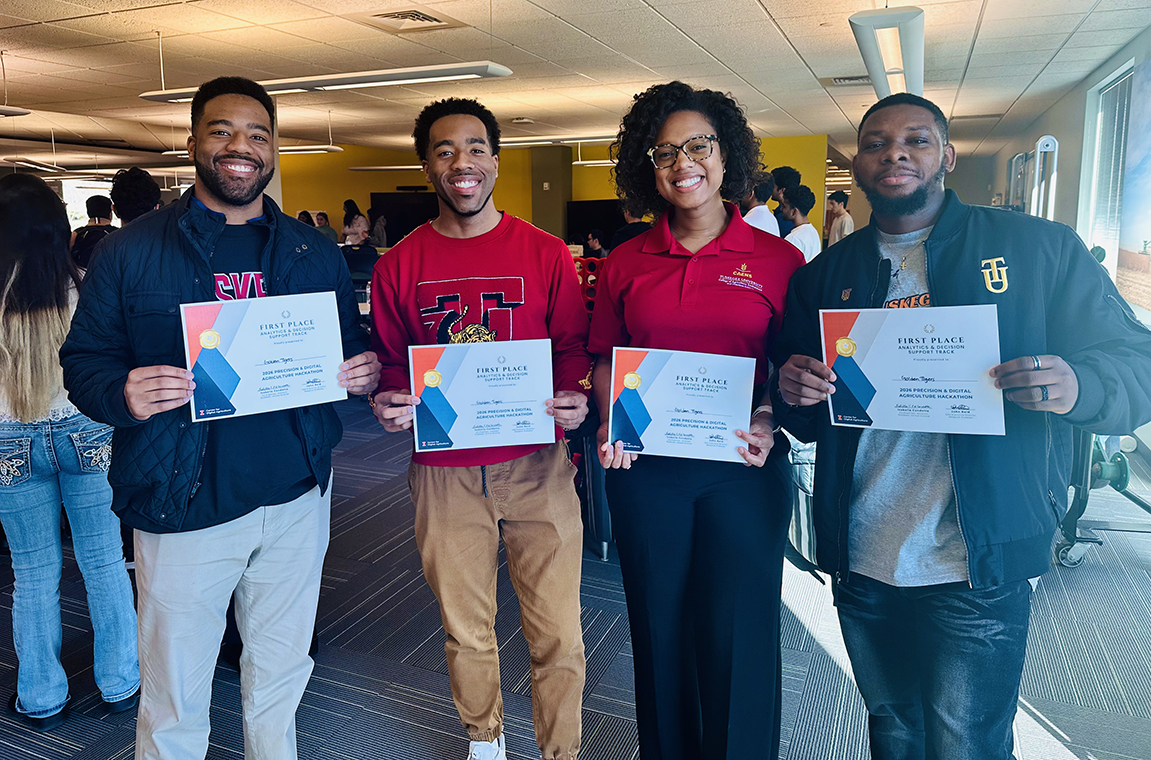
Tuskegee students earned first place in the Analytics and Decision Support category of the three-day National Precision Agriculture Hackathon by creating “CropVitals” using publicly available crop-relevant information, to ensure that farmers—particularly those with limited financial resources—can benefit from precision agriculture, which uses GPS, drones and artificial intelligence to apply water, fertilizer or seeds, without relying on expensive proprietary platforms or infrastructure to make the best decisions for maximum crop yield.
They participated in the university’s Center for Digital Agriculture 2026 Champaign-Urbana AgTech Week at the John Deere Innovation Center in Urbana, Illinois.
And the team – Eniola Olakanmi, Ph.D. candidate in Agricultural and Environmental Sciences Engineering, Meghan Franklin, Ph.D. student in Agricultural and Environmental Sciences Engineering, Cameron Jones, a senior Computer Science major and his twin brother Kalon Jones, a senior Computer Science major – came out on top, even after missing one full day of the event because of airport travel disruptions.
“Tuskegee students are being prepared to solve the world’s most complex, real‑world problems—just as George Washington Carver once did for farmers facing economic hardship caused by soil depletion,” said Dr. Mark A. Brown, President and CEO of Tuskegee University. “What made this win extraordinary was their resilience. Despite travel disruptions, they showed up, adapted, and won. That determination and problem‑solving mindset is #TheTuskegeeWay in the Renaissance Era of Tuskegee University.”
Faculty advisors Dr. Gregory C. Bernard, Associate Professor of Plant Sciences, and Dr. Joseph E. Quansah, Director of Agricultural and Environmental Sciences Engineering and the Geospatial Center, provided guidance and support throughout the competition. Ariel Polk, AI FARMS Program Manager, and Dr. Olga Bolden-Tiller, Dean of the College of Agriculture, Environment, and Nutrition Sciences, were also a big part of the team’s support system.
“One of the biggest challenges for many farmers today is not simply access to data, but access to tools that make that data useful,” said Dr. Bernard. “CropVitals helps address this by bringing together publicly available crop-relevant information and translating it into a clear, practical indicator to support better decision-making. When technology meets farmers where they are, it has the potential to level the playing field in ways that matter.”
The hackathon centered on a critical global issue: how farmers can produce more food using fewer resources while facing increasing environmental pressures, rising input costs, and economic uncertainty. Rather than developing theoretical concepts, participants were required to build real solutions using cutting-edge tools such as artificial intelligence, machine learning, and remote sensing technologies.
Working collaboratively across disciplines, thinking creatively under pressure, utilizing the latest tools in AI, app development, and programming, the team stayed focused on building a solution with practical impact.
“Our goal was to create something that farmers could realistically use,” said team member Cameron Jones. “Precision agriculture shouldn’t be limited to those who can afford expensive tools. With the right data and thoughtful design, impactful solutions can be built using open resources.”
CropVitals integrates data from multiple trusted sources, including Sentinel‑2 satellite imagery for vegetation and crop health analysis, NASA POWER data for atmospheric conditions and evapotranspiration, and USDA SCAN data for soil moisture monitoring. By combining these datasets, the team developed a Crop Vitality Score, which translates complex agricultural data into three easy-to-understand categories: Healthy, Monitor, and High Stress. This simplified scoring system allows farmers to quickly assess field conditions and make informed management decisions without requiring advanced technical expertise. In addition to the scoring dashboard, CropVitals delivers AI-driven field recommendations tailored to current conditions and produces downloadable reports that farmers can use for planning, recordkeeping, and decision documentation.

As Dr. Brown noted, this project is a fitting hat tip to George Washington Carver’s Jesup AgriculturalWagon, one of the most influential innovations in Cooperative Extension history. First introduced in 1906, Carver’s Jesup Wagon served as a mobile classroom, bringing hands-on agricultural education directly to farmers and sharecroppers across rural communities. Through demonstrations and practical instruction, the wagon helped farmers improve crop production, soil health, and economic stability using accessible knowledge and resources.
More than a century later, CropVitals carries that same spirit forward—replacing the wagon with digital tools and satellite data while maintaining the mission of empowering farmers through education, innovation, and equity.
“This team was focused, innovative, and deeply energized by the project's purpose, added Dr. Bernard. “They were not just trying to build something impressive for a competition – they were working to create something that could have real value for agriculture and farmers. Their combination of technical skill and genuine mission-driven commitment is exactly what moves a good idea into something that can make a real difference.”
© 2026 Tuskegee University