 Innovation strengthens Tuskegee’s trajectory toward Carnegie High Research (R2) Goal
Contact: Crystal Drake, Office of Strategic Communications
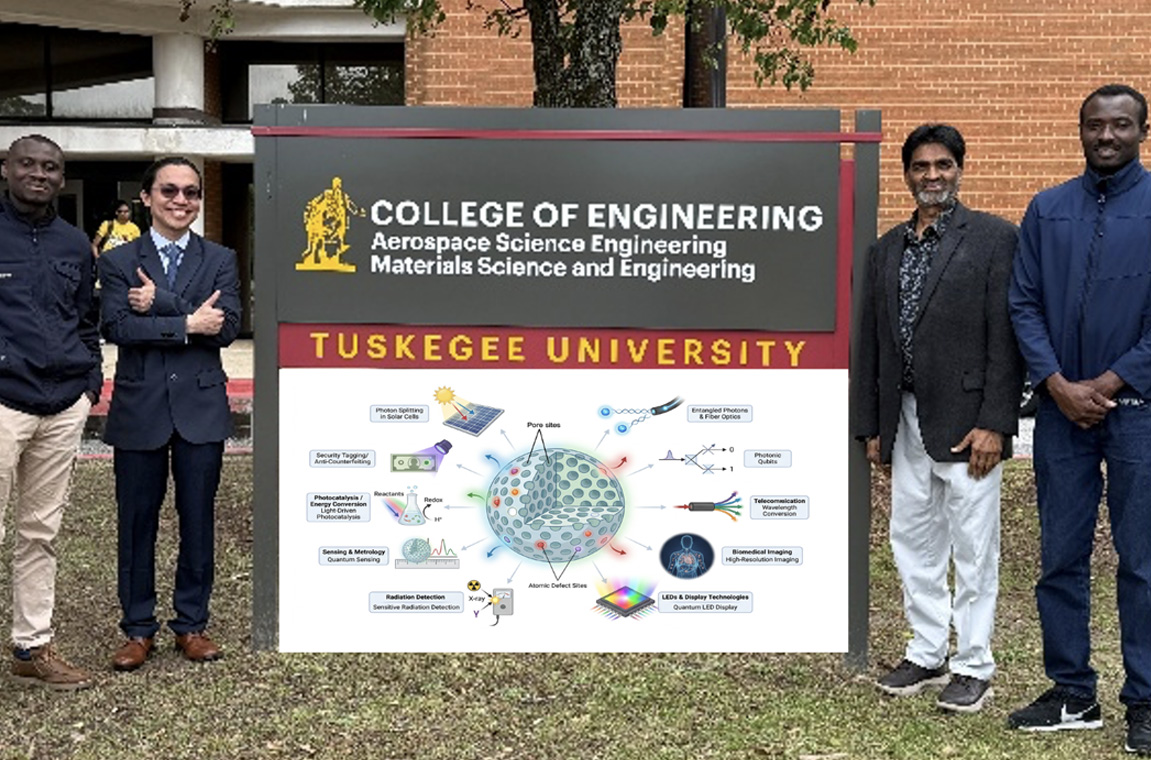
Researchers at Tuskegee University are advancing the frontiers of quantum science with the development of a groundbreaking metal oxide–based quantum emitter—an innovation poised to accelerate next-generation advances in quantum computing, communications, and sensing technologies.
Led by the Department of Materials Science and Engineering (MSE) in the College of Engineering (COE), the discovery has been submitted as part of a provisional U.S. patent application. The breakthrough underscores Tuskegee’s expanding national footprint in high-impact, cutting-edge research.
This latest achievement builds on a strong innovation pipeline within the College of Engineering, which has recently produced more than 12 patents—10 of them in advanced materials. The project is led by Dr. Vijaya Rangari, Professor and Associate Vice President for Research and Sponsored Programs, in collaboration with researchers at the University of Nebraska–Lincoln. This project is funded by the National Science Foundation (NSF-PREM).
This new patented technology is another example of Tuskegee’s legacy of leading innovation, in this case through Materials Science, which remains at the core of modern innovation. It enables stronger, lighter and more efficient technology, increasing the power of alternatives to fossil fuel, and fast-tracking advances in healthcare through improved medication devices and treatment options.
“Because these materials can be integrated into a wide range of devices and solutions, they hold tremendous potential for solving complex real-world challenges,” Dr. Rangari added. “That impact-driven innovation is a hallmark of Tuskegee’s mission.”
The Tuskegee research team includes Ph.D. scholars Faruk Soso, Ignatious Ebo-Quansah, and Kowsar Rezvanian. They are joined by the Nebraska team led by Dr. Peter A. Dowben, with graduate researchers Wai Kiat Chin, Peace Ikeoluwa Adegbite, and Gauthami Viswan.
“We are seeing exciting progress,” said Dr. Rangari. “Our team has successfully engineered a new class of porous manganese cobalt ferrite nanoparticles using a simple, scalable microwave synthesis technique—opening new pathways for practical quantum device integration.”
Unlike many emerging quantum materials, these nanoparticles are designed for versatility and real-world application. Their adaptability makes them especially promising for integration into advanced technologies, from secure communications systems to high-performance computational platforms.
Nanoparticles – tiny matter so small that it is measured in nanometers (about 1 billionth of a meter) – are already embedded in the technologies used daily, from phone screen to lifesaving medicines. They are central to breakthroughs across nearly every modern industry. For example, silver nanoparticles are used in everything from water filters to clothing to fight bacteria. Lipid nanoparticles made the COVID-19 vaccine possible by enabling rapid development and the safe introduction of the vaccine into human cells. The class of nanoparticles in the Tuskegee/Nebraska team’s patent will help expand similar capacity, advancing the next wave of transformative technologies.
Dr. Heshmat Aglan, Dean of the College of Engineering, emphasized the strategic importance of materials science to Tuskegee’s research growth.
“MSE is central to Tuskegee’s research identity,” said Dr. Aglan. “We are actively recruiting more research faculty with expertise in new materials to expand our research with an emphasis on applied research projects. We are also strategically hiring faculty in other engineering departments who can augment the materials science research.”
As Tuskegee University targets Carnegie Research 2 (R2) designation by 2027, the College of Engineering is accelerating efforts to recruit highly qualified Ph.D. students from around the world. These efforts are designed to elevate research output, expand global collaboration, and increase competitiveness for major research funding.
Because Materials Science bridges several disciplines, including physics (how materials behave), chemistry (composition and reactions, and engineering (applications and design), it plays a pivotal role in driving multidisciplinary research across the university and access to greater research funding—essential components of achieving R2 status.
“Material Science research sits at the intersection of many of today’s most pressing technological and societal challenges,” said Dr. Rangari. “From clean energy to AI hardware to medical devices, nearly every modern breakthrough depends on better materials. It is a field that quietly—but powerfully—shapes the future.”
© 2026 Tuskegee University