Contact: Crystal Drake, Office of Strategic Communications
Tuskegee University’s Renaissance Era continues to tap into ever-relevant founding principles to fuel its advancements goals.
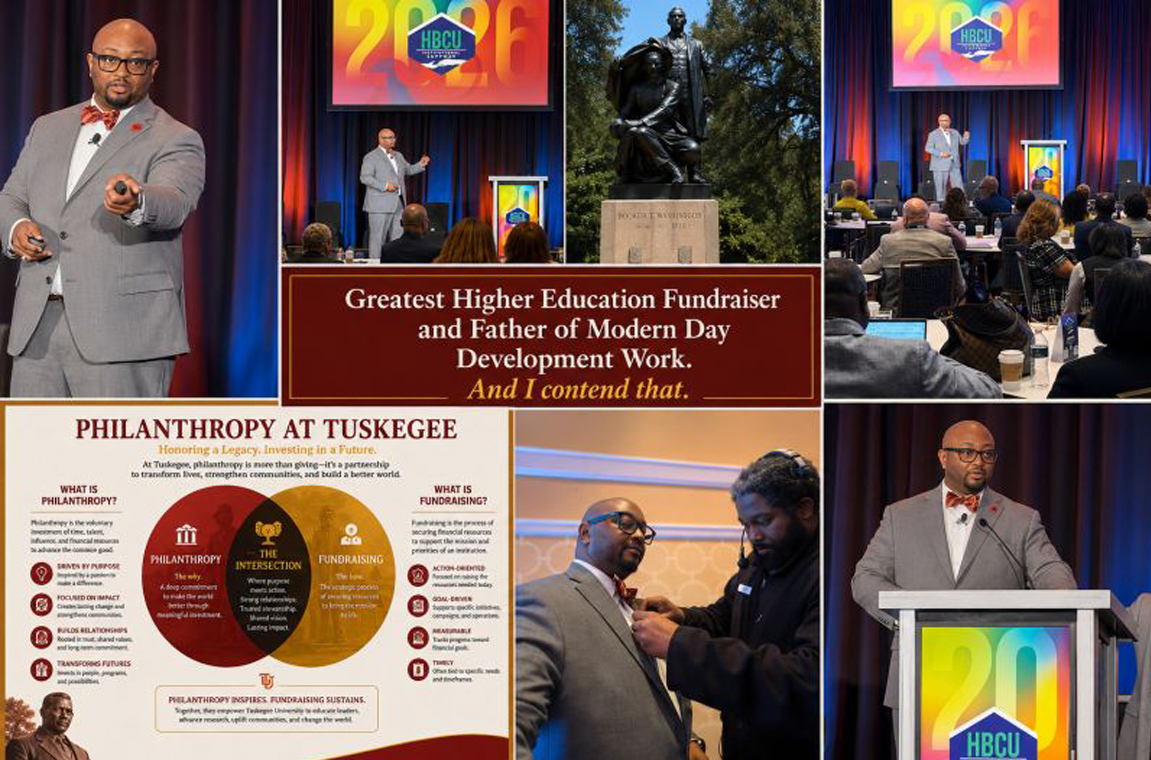
Earlier this month, Dr. A. L. Fleming, Chief Business Officer and Vice President of Development represented Tuskegee at The HBCU Philanthropy Symposium hosted by Delaware State University, a three-day event to support HBCU advancement professionals in their work to drive student success, enhance student-talent pipelines and career pathways, grow alumni engagement, secure scholarship money, and build innovative partnerships with other schools and the private sector.
In his presentation, “How Booker T. Washington Did Philanthropy and How It Informs Our Actions Today” Dr. Fleming explained the clear through line from Washington’s vision and his extraordinary fundraising success to Tuskegee’s current advancement strategies, which include
The Campaign for Tuskegee University, a multi-year institutional initiative with a goal of $300 million.
“What if Dr. Booker T. Washington’s greatest legacy wasn’t simply the money he raised—but the philanthropic leadership model he built?” Dr. Fleming posed as the centerpiece of his remarks.
He added that Washington is arguably one of the greatest fundraising role models in the history of higher education.
It was Washington’s contemporary, W.E.B. Du Bois, who coined the phrase the “Tuskegee Machine” to describe the robust, far-reaching network of support and genuine relationships – with the local community and across the globe – that Booker T. Washington created and grew during his leadership. Washington cast a wide net to find national allies who helped secure significant philanthropic support, political patronage and funding for the university.
Throughout the presentation, Fleming reflected on Washington’s advancement prowess by reminding the audience that transformational philanthropy begins long before a request is made to a potential donor.
He also outlined key factors that must be in place before the ask including a compelling vision, putting the right people in place to build authentic relationships and ensuring that institutions clearly demonstrate all of the reasons they are worthy of an investment. These attributes can be found in Washington’s iconic legacy, as well as pure grit and determination.
He arrived in Tuskegee in June 1881 to serve as the founding principal of the school where he was tasked with turning 100 acres of largely undeveloped land and $2,000 which had been appropriated by the Alabama legislature into what would become Tuskegee Institute. The school opening a month later on July 4.
“More than a century later, our technology, tools, and tactics have changed, but the principles that guided Washington’s work – and made Tuskegee possible – remain remarkably relevant for higher education leaders today,” said Dr. Fleming.
“Washington’s leadership will continue to inform and strengthen our institutions as we support the vital role HBCUs play in developing the next generation of leaders who will solve the world’s most complex problems,” he said.
© 2026 Tuskegee University