Contact: Crystal Drake, Office of Strategic Communications
First Delivery of Care at the Annual Prostate Cancer Awareness Health Fair in Shorter Alabama on September 26
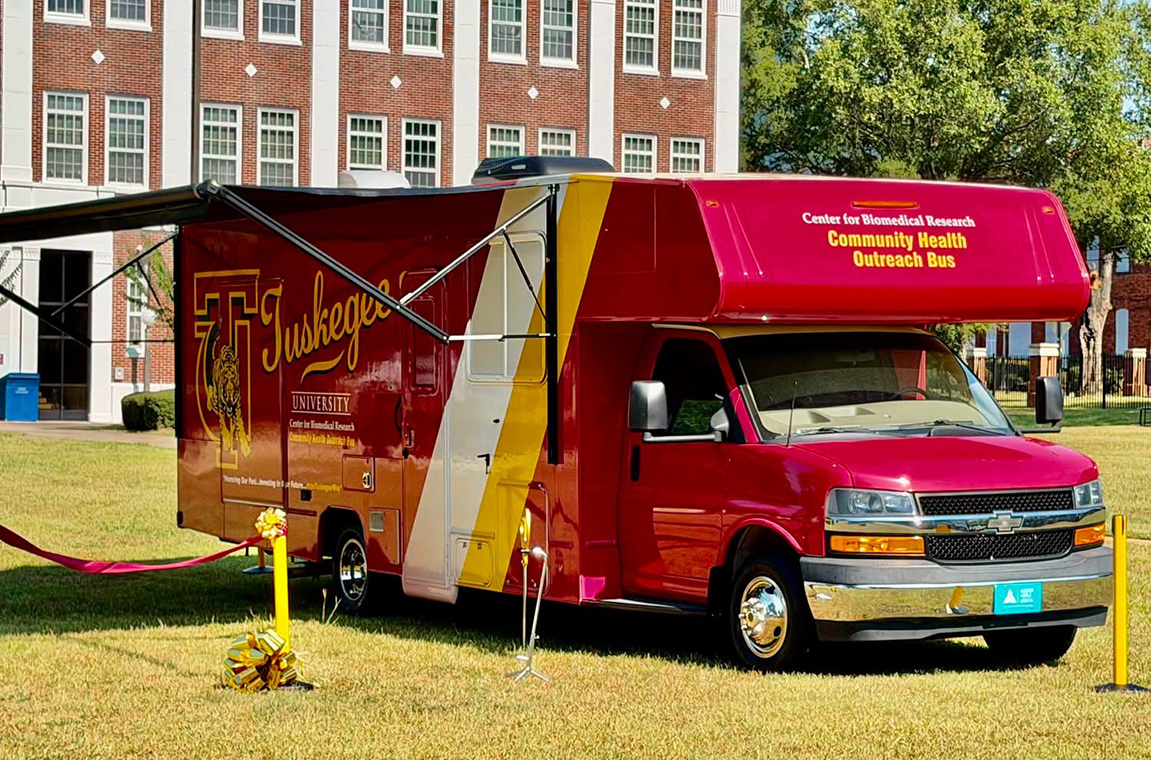
In the Renaissance Era, Tuskegee University continues to bring to life in new and innovative ways a legacy of service beyond the campus and into the wider Tuskegee community, meeting people where they are. At a recent ribbon-cutting last week, the university celebrated a significant milestone in its commitment to improving community health with the launch of the Community Health Outreach Bus (CHOB), which will deliver primary care services and social support directly to residents throughout Macon County and surrounding rural communities.
 “Access remains the highest barrier to the care people need. Access saves lives and this bus is an important step forward in Tuskegee’s commitment to serve and uplift our neighbors throughout Macon County,” said Dr. Thierno Thiam, Senior Vice President and Provost.
Managed by the Center for Biomedical Research, CHOB is staffed by faculty and students in Health Science, Behavioral Health, Biology, and Biomedical Research through collaborative efforts with departments across Tuskegee University such as the School of Nursing and Allied Health. CHOB features a station for face-to-face conversations and a private exam room. It is equipped with stations for blood pressure readings, drawing blood and urine sample to test for Diabetes and to provide mental health checks. Care providers will also share health information through videos, pamphlets and demonstrations.
Beyond expanding access to healthcare, CHOB will also support research initiatives funded through Tuskegee University’s Center for Biomedical Research (CBR), helping address rising rates of disease incidence and prevalence while strengthening connections between researchers and the communities they serve.
The launch of CHOB marks the culmination of years of planning and collaboration led by the Center for Biomedical Research under the leadership of renowned cancer researcher Dr. Deepa Bedi, Director of the Center for Biomedical Research and a professor of Biomedical Sciences. Since its creation, the Center has focused on improving health outcomes in Macon County and other rural communities that have historically been under-researched and underserved.
The Center for Biomedical Research serves as a cornerstone of Tuskegee University’s efforts to advance biomedical, clinical, and population behavioral research. The Center’s work is particularly focused on addressing the disproportionate impact of cancer on underserved populations through initiatives that increase the diversity of patient data available for translational research and investigate the biological and environmental factors associated with higher disease rates and poorer health outcomes.
This direct and in-person care isn’t new to Tuskegee. The Jessup Wagon was a mobile classroom and demonstration vehicle developed by Dr. George Washington Carver in 1906 to bring agricultural education directly to rural communities in Alabama. First it was a horse-drawn carriage, and later a mechanized truck – always on the move to reach and empower people, especially the overlooked and underserved.
The new outreach bus embodies that same idea and the Center’s mission of translating research into meaningful community impact.
“CHOB will quite literally put Tuskegee, and the groundbreaking research happening at the university, in motion,” said Dr. Thiam. “Research cannot remain within the walls of the labs. It must reach people, build communities and improve health outcomes. Knowledge brings with it the obligation to serve. That is who we are at Tuskegee. That is the Tuskegee Way.”
In remarks during the ceremony, Tuskegee Mayor Chris Lee reflected on the university’s longstanding role as a community partner and advocate for public well-being.
“Since Tuskegee’s inception, this university has been reaching beyond the campus to be a partner to the City of Tuskegee,” said Mayor Lee. “We will continue to support each other and the community as CHOB reaches our people to provide more access to healthcare.”
The event highlighted this deep relationship between Tuskegee University and the residents it serves.
Dr. Tim Turner, Vice President for Research, Sponsored Programs and Innovation, shared a moving personal story that underscored the community’s enthusiasm for the project to address critical gaps in care.
“When I went to the DMV to get the necessary permits for the bus, the person at the window was overcome with pride when I told her what CHOB was all about,” Dr. Turner said.
He described the encounter as a reminder of the trust and expectations community members place in the university. He added that successful community engagement begins with listening and that CHOB reflects “community-informed and community-responsive” core principles.
“Members of our community expect Tuskegee to make things right and take care of our fellow citizens,” he said. “We are bringing the community together.”
© 2026 Tuskegee University