Contact: Crystal Drake, Office of Strategic Communications
From a Sketch on a Napkin to a Center for Discovery.
What began nearly six years ago as a conversation among scientists and a sketch on the back of a napkin has become one of the most significant additions to Tuskegee University's research infrastructure in recent history.
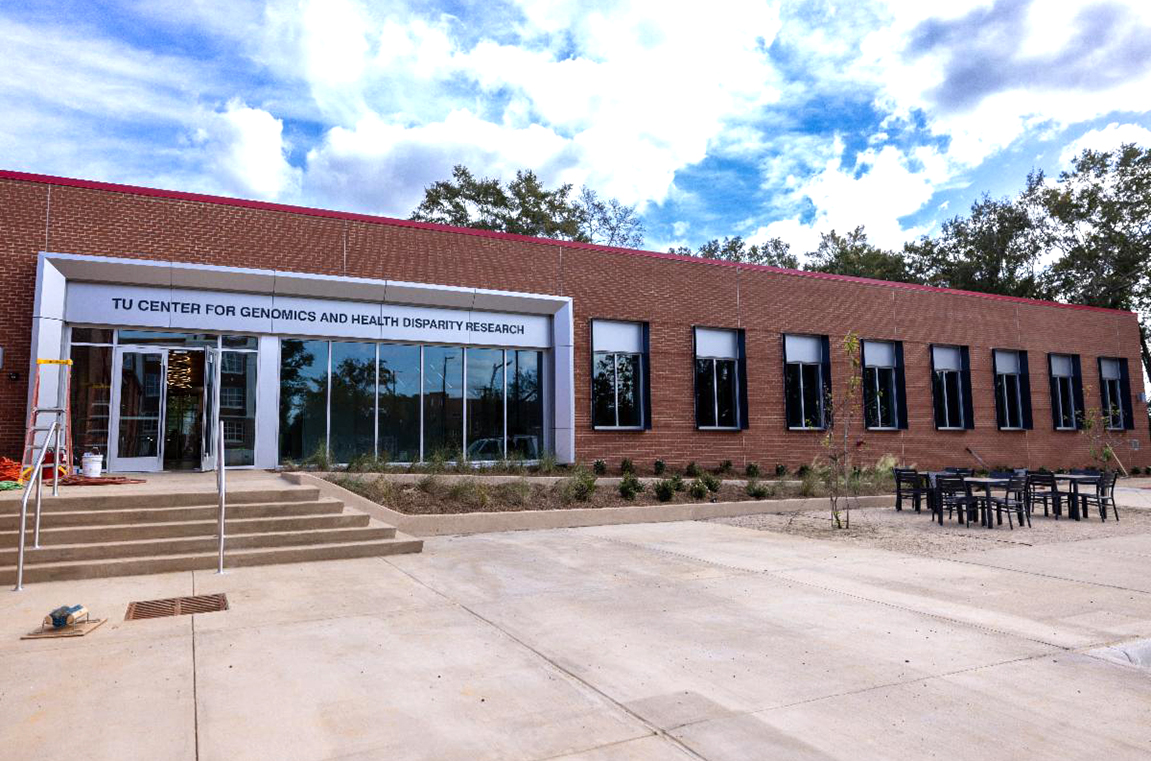
The newly completed Center for Genomics and Health Disparity Research, housed within the George Washington Carver Research Foundation, stands as a powerful symbol of vision, perseverance, and Tuskegee University's unwavering commitment to applying science to improve lives in Alabama's Black Belt and beyond.
The story is uniquely Tuskegee.

As university researchers discussed the resources and facilities necessary to conduct transformational scientific research, ideas started taking shape through hand-drawn renderings by Swarnali Ghosh Dastider, then a faculty member in Tuskegee's architecture program. Those early sketches evolved into professional architectural plans developed by Williams Blackstock Architects, setting in motion a project that would become a state-of-the-art research facility dedicated to advancing genomic science and addressing some of the nation's most pressing health disparities.
"This building is the realization of a dream years in the making," said Dr. Channa Prakash, dean of the College of Arts and Sciences and one of the key leaders who guided the project from concept to completion. “We have positioned Tuskegee to push the boundaries of genomic research, close inequitable gaps in healthcare, and train the next generation of scientists who will improve the human condition around the globe.”
The center also marks the latest chapter in a research legacy deeply rooted in the vision of George Washington Carver. More than a century ago, Carver laid a foundation for scientific inquiry with a $33,000 gift that sustained research at Tuskegee long after his lifetime. In the 1950s, Tuskegee scientists Dr. Russell Brown and Dr. James Henderson helped mass-produce cells used to validate the Salk polio vaccine. Later, important biomedical research led by Dr. Clayton Yates identified key biomarkers specific to aggressive prostate cancer in Black men. Dr. Yates became the director of the Center for Biomedical Research at Tuskegee.
Today, that legacy has evolved into a modern research enterprise dedicated to solving complex health challenges through innovation, collaboration, and discovery.
During the dedication ceremony, Tuskegee University President and CEO Dr. Mark A. Brown reflected on the institution's long history of scientific excellence and community impact.
"When George Washington Carver arrived here at Tuskegee, recruited by Booker T. Washington, he had to build from what others had thrown away," Dr. Brown said. "But very soon, the world beat a path to his door, seeking the excellence of his scientific research."
Brown noted that Carver's groundbreaking work in soil restoration and crop rotation transformed Southern agriculture because he believed research should directly serve the people who needed it most.
"He saved the economy of the South by teaching soil rotation to farmers, and he did it the Tuskegee Way by taking research, knowledge and science directly to where people needed it most," Dr. Brown said.
Drawing a connection between Carver's mission and the purpose of the new center, Dr. Brown emphasized the importance of conducting research that benefits underserved communities throughout Macon County, Alabama's Black Belt, and the nation.
"Your neighbors need you, this country needs you," Dr. Brown said to the faculty, researchers, and students gathered for the celebration. "Here in this Center, we are going to work with our heads, hearts and hands to create transformational change."
The approximately 9,600-square-foot facility offers a modern environment that supports cutting-edge scientific investigation and collaboration. The center houses advanced molecular and genomics laboratories, specialized research spaces, offices for faculty and graduate students, collaborative meeting areas, and integrated computational infrastructure for data analysis especially using advanced artificial intelligence tools.
Research will include studying DNA, genes, and molecular processes to better understand diseases and develop improved approaches for prevention, diagnosis, and treatment. A defining feature of the facility is its integration of laboratory science with computational biology, bioinformatics, and artificial intelligence. Scientists will use advanced computing tools to analyze large genomic datasets, identify disease-associated genetic variants, and discover biomarkers that can lead to earlier diagnosis and more precise treatments.
The center's research agenda focuses on diseases that disproportionately affect underserved populations, including cancer, diabetes, Alzheimer's disease, psoriasis, narcolepsy and other chronic health conditions.
Built through partnerships with the National Institutes of Health, Hope Enterprise Corporation, Stonehenge Community Development, JPMorgan Chase, Williams Blackstock Architects and Bailey-Harris Construction, the center officially opens debt-free, positioning it for long-term sustainability and impact.
Members of the Montgomery Rotary Club joined the celebration to affirm their partnership in that impact.
Among those present were civic leader Sam Adams, past president of the Club, and current Club president Henry W. Davis III, a member of Tuskegee’s Board of Trustees and a 1981 alumnus.
The organization announced a $125,000 contribution on behalf of Rotary District 6880, which includes 48 clubs across Alabama.
District Governor Steve Weaver described the new center as a gateway to opportunity and impact.
"As doors of the new center open, students are answering a call to improve public health, bringing life-saving research to so many, through this now open door," Weaver said. "Tuskegee University has been opening doors for generations, and we are proud to be your partners and invest in the people you will serve."
© 2026 Tuskegee University