Contact: Crystal Drake, Office of Strategic Communications
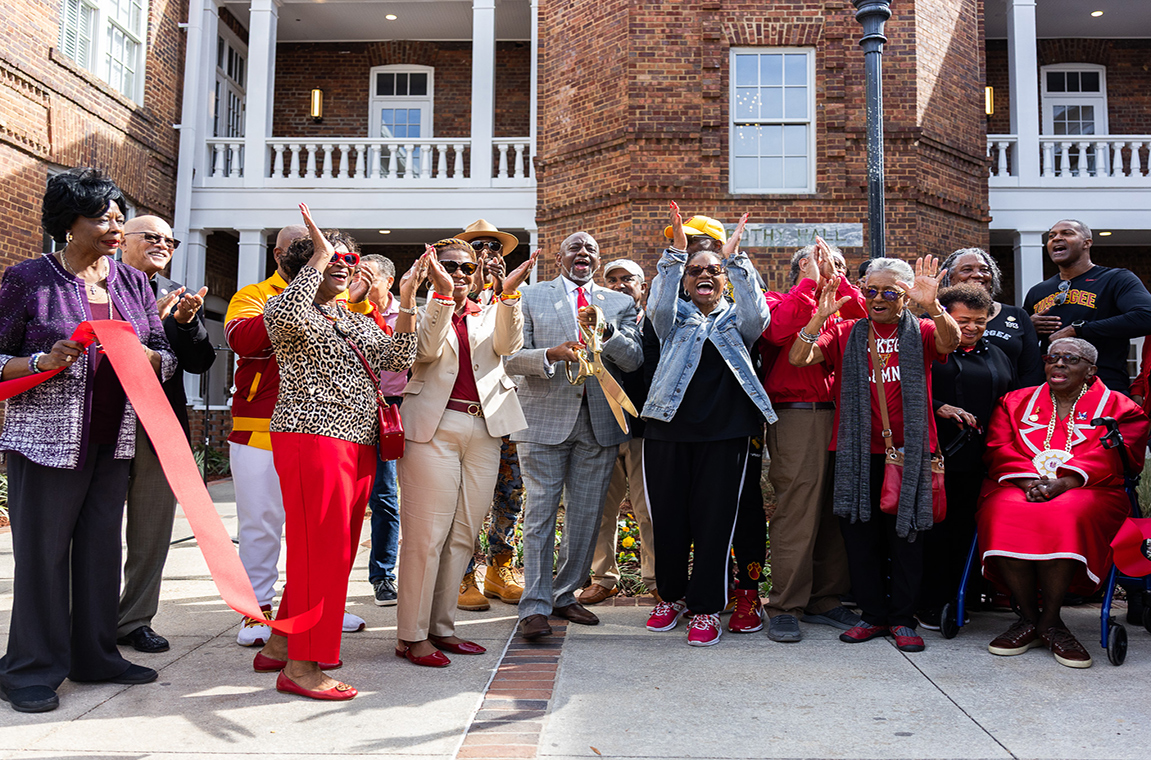
Alumni Gather for Ribbon-Cutting and President’s State of the University.
With cellphones up and heads turning to take it all in, alumni, faculty, staff and students walked with purpose into the Tuskegee University Kellogg Center during the Homecoming soft open. After an exciting ribbon cutting of the partially restored iconic space, now on the road to a full restoration, Dr. Mark A. Brown, president and CEO, gave his State of the University Address in the auditorium, keeping a promise to return alumni to a facility they have long loved.
The 168,000-square-foot meeting space, auditorium, ballroom and hotel served as the center of Tuskegee activities for decades. It was one of 11 Kellogg Conference Centers funded by the W.K. Kellogg Foundation for education and hospitality and tourism training and the only such facility at an HBCU.
Through the generosity of alumni and other supporters, the Kellogg Center is well on its way to a rebirth and soon after the ribbon snapped, several hundred guests toured the renovated lounge, ballroom, auditorium and courtyard.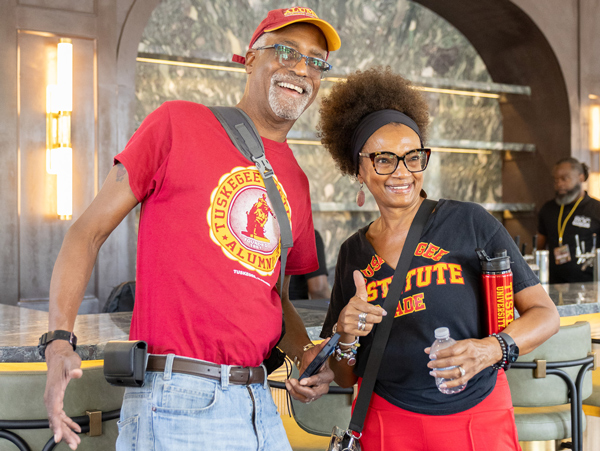
Coming home
“I applaud Dr. Brown’s leadership in making this happen,” said Ivy Pittman-Auten ’81 who served as Miss Freshman in 1976. “He is moving Tuskegee forward, as an alum who is very invested. He is one of our own.”
As she admired the new lounge, she added, “It is so beautiful to see how Tuskegee continues to evolve. This will always be home.”
Pittman-Auten was happy to see her classmate George Latham ’81 who was filled with powerful memories recalling that it was a Founders Day tour of the campus with his mother, an alumnus of the class of 1947, that convinced him on the spot that Tuskegee was his choice for college.
“Mother Tuskegee nurtured just as a parent would. It gave me options for my future,” said Latham.
The options – specifically the social and economic mobility and generation wealth-building – that a Tuskegee education has always afforded students was a key theme of Dr. Brown’s State of the University Address.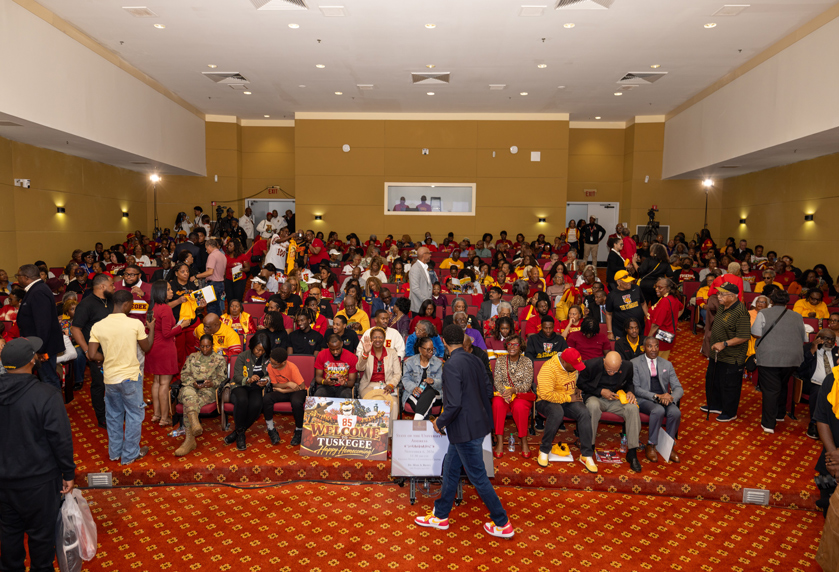
“History makes this point,” said Dr. Brown. “When Booker T. Washington arrived as the founding principal in 1881, 80 percent of Black Americans could not read or write – that’s who many of his students were – and yet his vision for Tuskegee to insist on unconditional excellence by creating graduates who would prosper was set in place.”
Dr. Brown went on to point out that by 1905, when the president of Harvard University, Charles Eliot, invited Washington to campus to learn about Tuskegee’s success, Eliot affirmed that there were more multi-millionaires who were Tuskegee graduates than those hailing from Harvard, Yale and Princeton combined.
Creating a template for success
“This model of excellence, known as the Tuskegee Machine, developed students with highly sought after skills, not just to take care of themselves but to be an advantage to the world,” said Dr. Brown. “If you know who you are – why would you change the model? That is who Tuskegee was – and who we are – and in this Renaissance Era, we are reigniting the Tuskegee Machine.”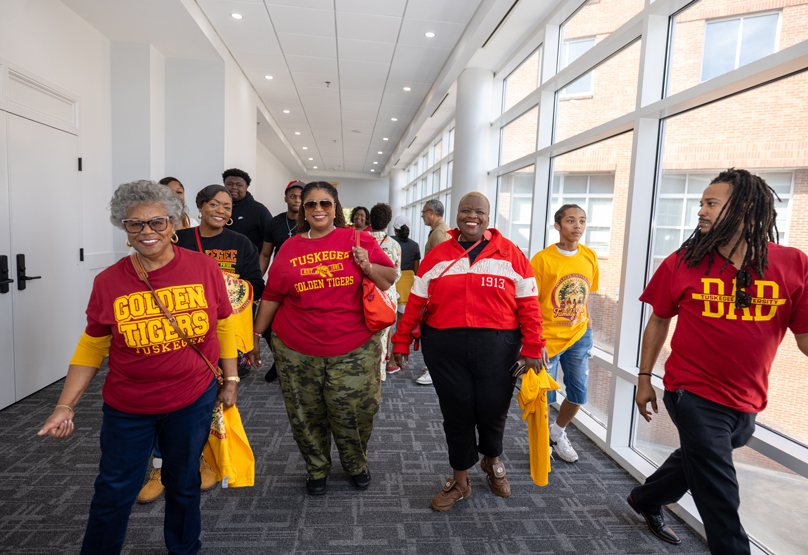
Dr. Brown outlined how The Renaissance Era’s focus mirrors the university’s original mission by assuming students could achieve excellence and cultivating their talent to make immediate impact with skills employers sought most.
“Tomorrow’s scientists, pilots, engineers, nurses and veterinarians are training right here at Tuskegee,” he said, noting that 51 percent of Tuskegee students are majoring in STEM-related disciplines.
Dr. Brown emphasized that Tuskegee’s standards are unapologetically rigorous and purposefully set to exceed national measurements – in the incoming freshman class ACT, SAT and GPA stats were all higher than the national freshman average – to position graduates ahead of others in pursuit of careers in high-paying fields.
Dr. Brown shared plans for the university to increase multiple pathways to student success, including the Tuskegee University Global Campus, an online learning experience that will launch in the fall of 2027, and announced a recent $7.5 million Department of Labor grant that will create a skilled trade curriculum offered by The Robert R. Taylor School of Architecture and Construction Science.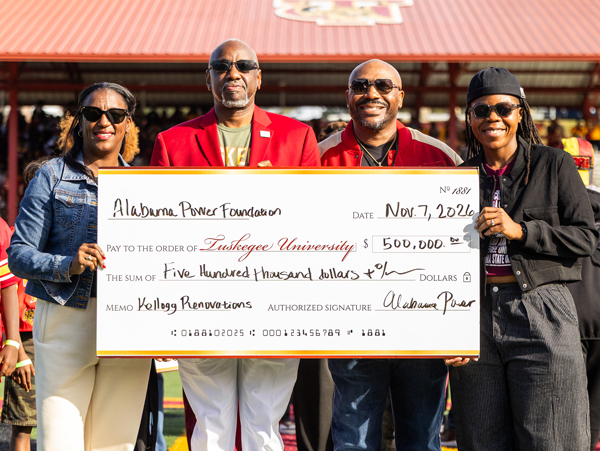
He outlined the next steps for the university after its prestigious designation in September by The Department of War as a Distinguished Military College, including strategies to increase ROTC scholarship opportunities and to establish a centralized state-of-the-art Corps of Cadets barracks and leadership training facility – continuing a century-old legacy of producing highly qualified military leaders prepared to serve the nation.
Confident that the university will continue to be “a global force,” Dr. Brown also made it clear that welcoming an ever-increasing enrollment, increasing academic curriculum, and accelerating major infrastructure expansion, including more renovations to The Kellogg Center, will require robust financial support from alumni.
“We must show evidence that we believe in Tuskegee through our philanthropy,” said Dr. Brown. The university is currently working The Campaign for Tuskegee University, a $300 million comprehensive initiative.
“What is the state of the university? We are thriving,” he said.
© 2026 Tuskegee University