Contact: Crystal Drake, Office of Strategic Communications
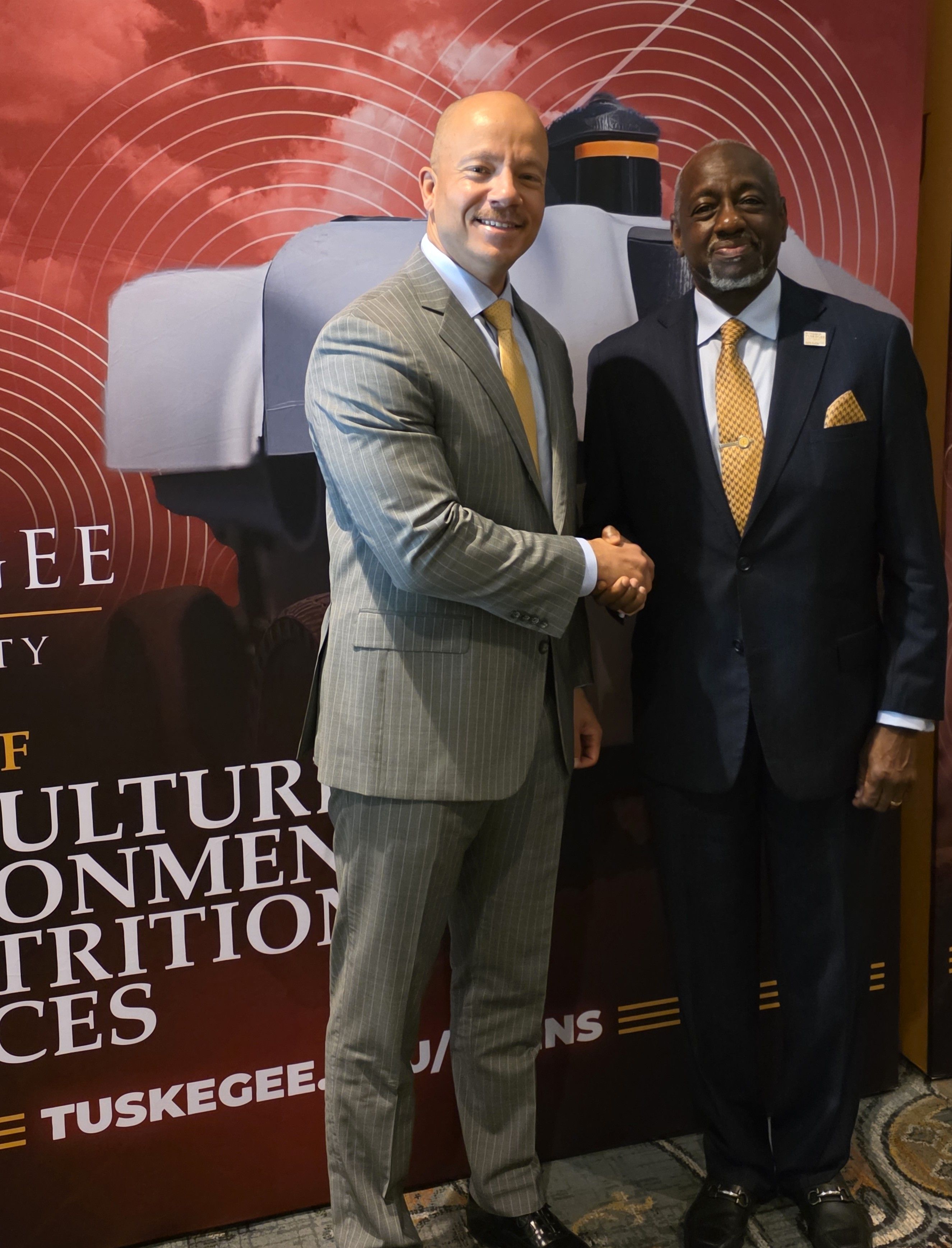
Assistant Secretary Westhill Sees Research Outcomes and Talent Pipeline Up Close
U.S. Department of Agriculture Assistant Secretary for Civil Rights Devon Westhill asserted the federal government's commitment to 1890 Land-Grant Universities at the 84th Annual Professional Agricultural Workers Conference (PAWC) convened this week in Montgomery, Alabama, by asking and answering a powerful question: “Why am I here? Because the ROI for the federal government’s investment is here.”
Westhill chose Tuskegee to launch a first of its kind nationwide USDA tour of the nation's 19 1890 Land-Grant Universities, HBCUs that were created in part through the support of the 1890 Morrill Act with the express purpose of developing highly skilled agricultural experts.
Dr. Mark A. Brown, president and CEO, said the conference, themed “Deep Roots: Rich Yields. Leadership, Legacy, and the Land-Grant System,” put focus where it belongs, on the indisputable legacy of economic outcomes delivered to the U.S. economy by the institutions Westhill intends to visit.
"Tuskegee's research capabilities and our student success model continue to train students who graduate ready to make immediate impact on critical challenges facing people across the country,” said Dr. Brown who is also an executive officer of The Council of 1890 University Presidents, a collective body focused on advancing a comprehensive strategy to strengthen congressional and federal policies and programs impacting those institutions.
“And particularly for communities, like those across the Black Belt, that have historically been under-researched, underserved, and overlooked, our work is finding solutions that will eradicate food deserts, equipping farmers with state-of-the-art predictive technologies to stay ahead of crop disease, and making farming more profitable and sustainable. All of this work stabilizes and elevates local communities which ultimately increases the potency of the U.S. economy."
USDA Tour Begins at Tuskegee University
Prior to the conference opening, Assistant Secretary Westhill visited Tuskegee University on Sunday, touring the University's College of Agriculture, Environment and Nutrition Sciences (CAENS) and meeting with students presenting agricultural research projects.
The visit underscored USDA's effort to support and recruit talented 1890 institution students as the next generation of agricultural professionals. Westhill said the tour reflects USDA's commitment to extending a federal relationship with 1890 institutions – which is more than a century old – to expand their role in workforce development, institutional capacity building, and community outreach.
"This tour is about listening, learning, and building a roadmap for the future," Westhill said. "The USDA's relationship with the 1890 universities spans more than a century because these institutions consistently deliver tremendous returns on federal investment through research, innovation, workforce development, and community engagement."
He added that the universities serve as critical engines for economic growth, particularly in rural communities and throughout the Black Belt region.
"Like Tuskegee, these institutions consistently produce highly skilled and highly motivated professionals who are committed to serving their communities," Westhill said. "That strengthens regional economies, creates opportunity, and ultimately benefits the entire nation."
Tuskegee University's Impact
Dr. Brown and Westhill spent time together discussing the university's long-standing contributions to agricultural innovation, economic development, and community advancement.
Although Tuskegee has always been included in the federal definition of a land-grant institutions that receive funding to advance this work, the university does not receive the mandated 1:1 state match of federal land-grant funds.
Dr. Brown would like to see this oversight corrected.
“I agree with Assistant Secretary Westhill’s calculus on the high return on investment the university represents,” said Dr. Brown, “not because of bias but simply because of the math. Tuskegee-supported Extension Services served more than 3500 people last year and assisted farmers in securing more than $800,000 in loans and grants. Overall, the university generates more than $300 million in economic impact in the state.”
Dr. Brown is confident that with a funding parity adjustment that aligns with the stated goals of 1890 funding, the university will accomplish exponentially more positive outcomes for the people of Alabama, the region and the country.
“Our impact reflects both the long-game and success right now,” said Dr. Brown. “According to the CDC, Alabama ranks number one in the nation in morbid obesity. At The Carver Genomic Research Center on our campus we are researching the link between that health factor and cancer and training the next generation of researchers right here where patients live. We know diet is a major factor so we are giving our students a farm-to-table experience in our cafeteria every day. They have the opportunity to eat directly from a farm right there on campus, to learn the power of food choice and to reverse health habits that don’t serve them. All of this work reflects what has always been Tuskegee’s mission – to be the change we want to see and to solve very complex problems.”
Westhill is leaning in to learning from Tuskegee and other 1890 institutions.
“These institutions are helping create generational impact, and USDA is committed to ensuring that impact continues well into the future," he said.
PAWC traces its roots to the work of Booker T. Washington and the early Farmers Conference movement at Tuskegee, growing into one of the nation's most respected agricultural gatherings. The conference annually brings together researchers, educators, students, farmers, policymakers, and community leaders from across the nation to examine the future of innovation in agriculture, nutrition, community development and effective management of natural resources.
Montgomery news stations WSFA and WAKA covered Westhill’s visit to the PAWC Conference:
84th annual Professional Agricultural Workers Conference kicks off in Montgomery - WAKA 8
USDA officials visit P.A.W.C. and Tuskegee University
© 2026 Tuskegee University